Unopened commercial bottle
Keep it in a cool pantry until the date and storage directions on the package say otherwise. Protect it from direct sun and heat beside the stove.


Commercial sweet chili sauce usually does not need immediate refrigeration for safety the moment you open it, especially if it is an acidic shelf-stable bottle. But refrigeration is often the smarter everyday choice because sweet chili sauce is sugary, sticky, and prone to residue around the cap, so flavor, color, and overall cleanliness tend to hold up better in the fridge.
Sweet chili sauce sits in an awkward middle ground. It is usually more shelf-stable than a fresh homemade sauce, but it is also sweeter, stickier, and messier around the cap than a very thin vinegar-forward hot sauce. That is why the best storage answer is not just a lazy yes or no.
If you are dealing with a commercial bottle, pantry storage is often still acceptable for a while after opening. But if you want the bottle to stay cleaner, brighter, and more consistent over time, refrigeration is usually the better practical move. The sugar, garlic, chili solids, and syrupy texture all make sweet chili sauce feel older faster once the bottle has been opened repeatedly.
For a sealed commercial bottle, pantry storage is the default. Once opened, many sweet chili sauces can still survive in the pantry for a while because they are acidic, processed, and designed for shelf stability. USDA FoodKeeper guidance for chili sauce points in that direction for commercial products, and many manufacturers still treat the bottle as a stable packaged condiment rather than a fresh refrigerated food.
But that does not automatically mean the pantry is the best place after opening. Refrigeration usually gives you a cleaner bottle, slower color change, slower flavor fade, and less dried sauce crust around the neck. So the practical answer is this: a commercial bottle usually does not have to go straight into the fridge for safety, but it often should go there if you want the bottle to stay in better shape.
If you have already looked at related storage questions like does sriracha need to be refrigerated or does chili garlic sauce need to be refrigerated, sweet chili sauce lands between them. It is usually sweeter and stickier than sriracha, but often smoother and less solid-heavy than chili garlic sauce.
| Bottle condition | Storage decision | Reason |
|---|---|---|
| Unopened commercial bottle | Use the package's pantry direction | The sealed product remains under the manufacturer's original storage conditions. |
| Opened; label says refrigerate | Refrigerate | The product-specific instruction outranks general condiment advice. |
| Opened; label permits pantry storage | Cool pantry for fast use, fridge for slower use | Cold storage usually preserves color, flavor, and cap condition longer. |
| Homemade or transferred without directions | Refrigerate | The commercial process and storage instruction no longer support a pantry assumption. |
Sweet chili sauce is not just hot sauce with extra sugar. It often includes vinegar, sugar or syrup, garlic, chili, starch or gums, and enough body to coat food instead of splashing across it. That texture changes how the bottle ages after opening.
A very thin hot sauce can stay relatively tidy because it pours cleanly and leaves less buildup behind. Sweet chili sauce tends to leave more residue under the cap, around the rim, and down the bottle neck. That sticky residue is not the same thing as the whole bottle spoiling, but it does make the bottle feel older and lower quality sooner.
The sweeter formula also means flavor drift becomes obvious faster. When sweet chili sauce loses brightness, it can start tasting flatter, darker, or more candy-like instead of balanced. If the sauce uses starches or thickeners, temperature swings can also make the texture feel less clean over time. That is one reason some bottles look more stable in the fridge than in a warm cabinet.
This is also why sweet chili sauce should not be judged by the same standards as an ultra-thin fermented bottle discussed in why hot sauces separate or the thicker texture fixes in how to thicken hot sauce. The storage job is different.
Pantry storage still makes sense when the bottle is commercial, the label does not require refrigeration for safety, and you use it often enough that it will not sit half-open for months. A cool cabinet away from the stove is much better than a warm shelf beside the oven or a sunny windowsill.
This is the strongest case for keeping it out: you opened a shelf-stable bottle recently, the kitchen stays fairly cool, the cap stays clean, and the bottle is moving fast. In that scenario, refrigeration is more about preserving peak quality than preventing an immediate food safety problem.
Keep the cap closed between servings and pour sauce into a separate dish for dipping. Returning table sauce, food crumbs, or a used utensil to the bottle changes the storage conditions that the package guidance assumes. A smaller clean serving portion protects the main bottle whether it lives in the pantry or refrigerator.
It also helps to follow the label over internet folklore. Some brands explicitly tell you to refrigerate after opening. Others position the sauce as a shelf-stable condiment first. If the bottle gives a direct instruction, that instruction outranks generic advice.
Keep the original label available after transferring sauce into a smaller dispenser. The ingredient list, lot information, date, and storage direction disappear when an unmarked squeeze bottle replaces the package. Refill only a clean, dry dispenser and avoid topping a new portion onto old residue.
A restaurant-style bottle on the table does not prove the same product can live indefinitely in a home pantry. Service volume, cleaning routines, package size, and manufacturer instructions may all differ. Use the conditions in your own kitchen and the directions for your bottle.
Write the opening date on a bottle that will be used slowly. The date does not replace the manufacturer's guidance, but it removes the guesswork that begins when several similar condiments collect in the cabinet. It also helps explain whether darkening happened over a few weeks or after a much longer period.
Storage location should stay consistent. A cabinet above a dishwasher, beside an oven, or in direct afternoon sun is not equivalent to a cool pantry. If the only available cabinet runs warm, refrigeration is the more predictable choice even when the label allows room-temperature storage.
That same rule applies across the broader condiment family. If you compare sweet chili sauce with chili paste storage or even a broader hot sauce spoilage guide question, label handling and ingredient mix matter more than a one-size-fits-all answer.
Even when pantry storage is technically acceptable, the fridge often wins in real life. Sweet chili sauce is one of those condiments that can stay usable in the cabinet while still aging in a way that feels obvious and annoying. The bottle gets sticky. The cap gets messy. The sauce darkens. The top layer around the opening starts looking rough even though the main bottle is still probably fine.
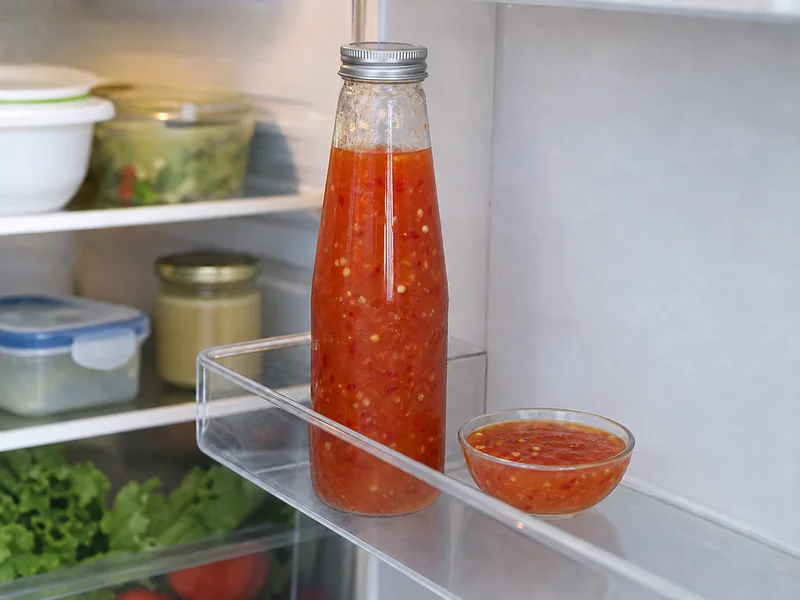
Refrigeration slows those changes down. It helps preserve a fresher sweet-acid balance, reduces oxidation speed, and usually keeps the cap area from turning into a sugary ring of dried sauce. If the bottle is only used occasionally, the fridge is the safer practical home.
This matters even more if multiple people use the bottle, if the cap is handled with sauce-coated fingers, or if the bottle is opened frequently during meals. Each opening adds air exposure and handling mess. That does not guarantee spoilage, but it does push the bottle away from peak quality.
So the fridge answer is less about fear and more about realism. If you know the bottle will linger, refrigeration is usually the better choice.
Cold sweet chili sauce pours more slowly, especially when starch or gums give the product body. That change does not mean the sauce has spoiled. Let the bottle sit only long enough to pour, or place the amount needed for the meal in a clean serving dish and return the main bottle to the refrigerator.
Avoid repeatedly warming and cooling the entire bottle to make it run faster. Frequent temperature changes add handling time and leave more sauce around the cap. A clean spoon or squeeze bottle tip solves the serving problem without changing the storage plan.
For glazing hot food, measure the chilled sauce before cooking begins. It will loosen as it warms on the food, so adding extra because it looks thick in the bottle can leave the finished dish overly sweet or wet.
Homemade sweet chili sauce is a different category entirely. Once you start from fresh chilies, garlic, sugar, vinegar, and your own cooking method, you lose the predictable factory formula that makes a commercial bottle easier to trust at room temperature.
If you make your own sauce, treat it as fridge-first unless you are following a tested preservation process built for shelf stability. A homemade batch may taste sharp enough, but taste is not a substitute for measured acidity, validated processing, or sealed packaging.
This is the same reason homemade sauce should not borrow rules from commercial hot sauce articles or from a general make hot sauce process page. Homemade sauce lives much closer to cooked food storage than to sealed retail-condiment storage.
If your homemade sauce includes fruit puree, extra garlic, cornstarch, or other fresh add-ins, the case for refrigeration gets stronger, not weaker.
Transfer a homemade batch to a clean container, date it, and avoid returning a used tasting spoon to the jar. Make only the amount you can use within the storage guidance of the tested recipe you followed. Freezing a portion is a better choice than guessing at a longer room-temperature life.
Keep the recipe and the storage instruction together when sharing a homemade jar. A recipient cannot infer acidity, processing, or expected refrigerator life from sweetness alone. If those details are unavailable, the jar should not be presented as a shelf-stable gift.
Sweet chili sauce does not need to look perfect to still be usable. Mild darkening, some thickening, or a sticky cap ring can all happen before the bottle is actually bad. What matters is whether you are seeing normal age or a real spoilage signal.
Use the whole bottle, not one sticky spot on the cap, to judge whether the sauce is declining. Dried sugar around the opening is common; growth, gas, and an unfamiliar odor point to a different problem.
If you are unsure, compare the situation to the quality-loss signs discussed in spoiled hot sauce signs. Sweet chili sauce follows the same broad common-sense logic, but the sticky sweetness makes visible aging show up sooner.
Keep it in a cool pantry until the date and storage directions on the package say otherwise. Protect it from direct sun and heat beside the stove.
Follow any refrigerate-after-opening instruction. When the label permits pantry storage, the fridge remains the practical choice for a bottle used slowly or handled often.
Refrigerate it unless it came from a tested shelf-stable preservation process. Fresh garlic, fruit, starch, and an unverified cooking method cannot borrow the commercial bottle's pantry rules.
The simplest routine is to read the label, date the bottle when it opens, wipe the rim before replacing the cap, and refrigerate when use is occasional. That keeps the decision tied to the actual product instead of a broad rule for every sweet chili sauce.